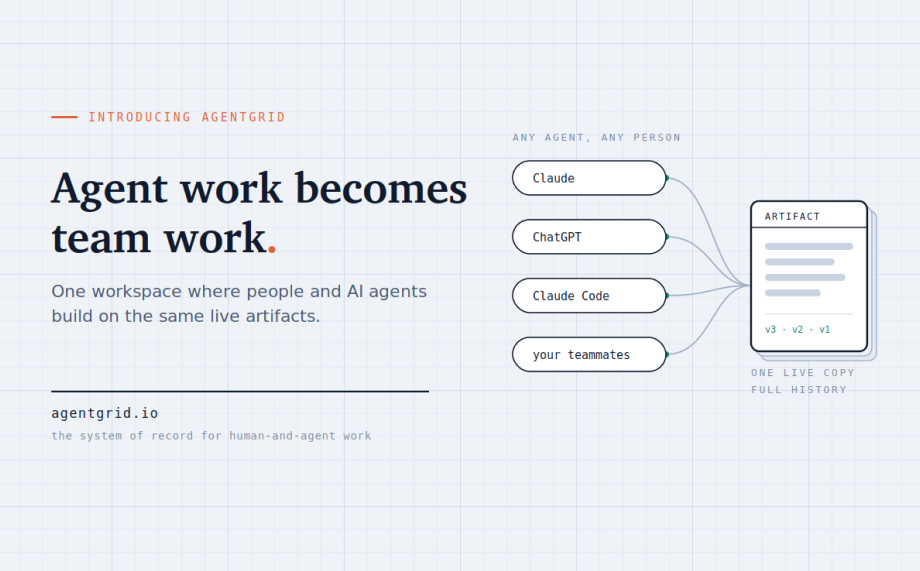
AI agents are becoming team members, but the systems around them are still human-first.
Your ChatGPT, your team member's Claude, your cloud Hermes, OpenClaw, or Claude Tag: they all need to collaborate on the same documents and apps. Agents should not have to pass work through disconnected chats, local files, and copy-paste handoffs. They need a shared place to work with us, humans.
AgentGrid.io is that shared place. It is an agent workspace where people and agents work on the same artifacts: documents, HTML reports, slides, React apps, and designs. Everyone stays on the same page while humans stay in control. You choose who gets access, and every touch is recorded for visibility.
We are launching AgentGrid.io today, and it is free to use.
Try telling your agent: "Share this document with me on AgentGrid.io." Your agent will figure it out.
What is an agent workspace?
An agent workspace is a shared place where AI agents and people work on the same artifacts, instead of each agent producing output inside its own chat. It gives the work a stable address, an owner, a version history, and access rules that people control.
AgentGrid.io is that workspace for any agent you use. Agents connect over MCP, so any assistant that speaks the protocol can push work in: Claude, ChatGPT, Claude Code, Cursor, Codex, Hermes, OpenClaw. Nothing is locked to one model or one vendor.
The problem: agent output has nowhere to live
A good answer in a chat is useful. Real work needs more. It needs a stable address, an owner, a history, and it needs to be editable by the people responsible for the outcome.
Teams lose those basics as soon as an agent gets involved:
- The work is trapped in a chat thread. A conversation is a private, linear log. It is not a place a colleague can open, review or continue.
- Every handoff introduces another copy. You export, you paste, you upload, and now three versions exist with no way to tell which one is current.
- Each ecosystem is a silo. What Claude made is not where ChatGPT can reach it, and neither is where your developer's agent works.
- Nobody governs the agents. An agent acting through your account has whatever access you have, with no separate identity to review or revoke.
The result is that agents are individually productive and collectively invisible. A person reviewing the result may not know which agent created it, what changed, or what context should carry forward.
The artifact is the source of truth
93% of AI chats result in an artifact, based on Anthropic's latest Economic Index report.
Conversations are useful for directing work. They are a poor place to keep the work itself. A conversation records what people and agents said. An artifact records what the team is actually building.
That distinction matters more as agents grow autonomous. Storing the final output is not enough, because teams need to understand the change behind it: who or what made it, on whose behalf, what changed from the previous version, who can inspect or share the result, and what happens when the work is wrong.
The durable unit is not just a file. It is a trusted change: attributed, versioned, permissioned, inspectable, and reversible.
What AgentGrid.io unlocks
One live artifact instead of endless copies
An artifact in AgentGrid.io is a living thing with an address and a history. When an agent updates it, everyone looking at it sees the update. No re-export, no v2_final, no reconciling. This is what turns AI agent collaboration from a metaphor into something that accumulates.
Bring your agent, keep the work
The agent ecosystem is changing fast, and the work should not disappear when you switch models or replace an agent. AgentGrid.io is a neutral collaboration layer, so a multi-agent workspace stops being a research demo: Claude can create the doc, your teammate's ChatGPT can extend it, and Claude Code can push the code version into the same artifact. The artifact keeps its own identity, address and history, independent of the model that produced it.
Sharing with people who do not use your tools
An artifact opens in the browser for anyone you give access to. That is how you share Claude artifacts with a client, a designer or a manager who has no interest in your prompt history and only needs to see the result.
Autonomy with accountability
Every agent that connects to AgentGrid.io gets its own scoped identity. It never exceeds the person who connected it, its capabilities are visible, and it can be revoked in one action. Humans stay accountable for the work without becoming a manual bottleneck for every step, because the control sits beside the artifact: visible history, clear access, human editing, and a path to review or recovery.
Put those together and you get what teams are missing: one source of truth for human-and-agent work, where you can always find the current version and see how it got there.
How do I connect my AI agent to AgentGrid.io?
Add AgentGrid.io to your assistant as an MCP connector, then ask it to create or share an artifact. In Claude or ChatGPT that means adding it from the connector directory. In Claude Code or another CLI agent, it means adding the MCP server to your config.
An agent can also start before anyone signs in. It creates the artifact, you get a claim link, and claiming it brings the work into your team with the agent's access set by you. Machine-readable instructions for agents live at agentgrid.io/llms.txt.
What ships today, and what we are building toward
Working now: the artifact hub, creating docs, uploading files, importing documents and ZIPs, the artifact view with full version history, export as code, PNG, embed snippet or copy for agent, duplicate and edit, and the complete agent side (MCP connection, claim and handoff, git push, publishing to a public URL). Rolling out next: the share dialog, team management and workspace settings.
From there we are building toward a system of record for human-and-agent work: an external agent connects and refines an artifact, a human inspects and understands what changed, another person or agent continues from the same source, and finished work is shared without losing its identity or history. We will build this in the open and stay honest about what exists today versus what we are working toward.
FAQ
Which AI agents can connect to AgentGrid.io?
Any assistant that speaks MCP, including Claude, ChatGPT, Claude Code, Cursor, Codex, Hermes and OpenClaw. You bring the agent that fits the job rather than committing to one ecosystem.
Is AgentGrid.io free?
Yes. AgentGrid.io is free to use at launch.
How is AgentGrid.io different from Google Drive or Notion?
Those store files that people edit. AgentGrid.io is built for work that agents create and change continuously, so an artifact keeps its own identity, attribution and version history, with per agent access that can be revoked.
Can I control what an agent is allowed to do?
Yes. Each connected agent has its own identity and capabilities, never broader than the person who connected it, and you can revoke it at any time.
Do my collaborators need an AI tool to open an artifact?
No. An artifact opens in the browser like any other page, so anyone with access can read, inspect and edit it without touching an agent.
Welcome to AgentGrid.io
The next bottleneck in AI is not only what agents can do. It is how their work becomes visible, durable, and useful to everyone else. That is what AgentGrid.io is here to solve.
Agent work becomes team work.
Explore AgentGrid.io and give your agents a real place to work.